The Strategic Value of Quick Wins in Public Space
How modular add-on seating elements transform existing structures into high-quality places to stay, without demolition or lengthy procedures.
Maximum Impact with Minimal Invasion
Quick wins in public space are targeted, strategic interventions that activate existing infrastructural structures without the need for invasive civil works or new foundations. By installing modular add-on seating elements on retaining walls and concrete edges, high-quality meeting and resting places can be created in a very short time, delivering clear added value for policy, management and design. This approach increases stay quality and encourages social interaction, while keeping the impact on the surroundings low and avoiding large-scale construction sites
For cities and municipalities, this offers a way to achieve visible improvements quickly within the existing spatial context. These interventions do not alter the structure of the space itself, but reinforce what is already there. Existing urban mass is repurposed as a carrier for new forms of use, comfort and encounter, without disrupting the character or legibility of the place.
In practice, this translates into a fast intervention with minimal disruption. Installation is typically completed within a single working day, without prolonged nuisance for residents or users. Because the work is carried out on existing structures, risks remain manageable and permitting processes are simplified. For maintenance teams, this results in a solution that remains inspectable, easy to maintain and aligned with the lifespan of the underlying infrastructure. The outcome is a comfortable seating solution that works not only today, but remains manageable in the long term.

Quick Wins as a Catalyst for a Liveable City
Within urban policy, quick wins function as a strategic instrument to improve public space step by step. They make it possible to respond quickly to changing patterns of use, societal expectations and local needs, without having to wait for large-scale redesigns that often require years of preparation. This creates room for experimentation, learning and adjustment based on actual use.
For policymakers, the added value lies in the combination of speed and flexibility. Quick wins allow tangible improvements to be delivered within a single political term, while still fitting within a broader long-term vision for the city. They are not an end point, but a deliberate first step in a phased development of places to stay and meet.
By activating existing locations rather than completely redesigning them, budgets can be used more efficiently and public support among users and stakeholders grows. What starts today as a light intervention can evolve into a structural component of a future-proof public realm, where use quality, management and policy reinforce one another.

From Existing Structure to a High-Quality Place to Stay
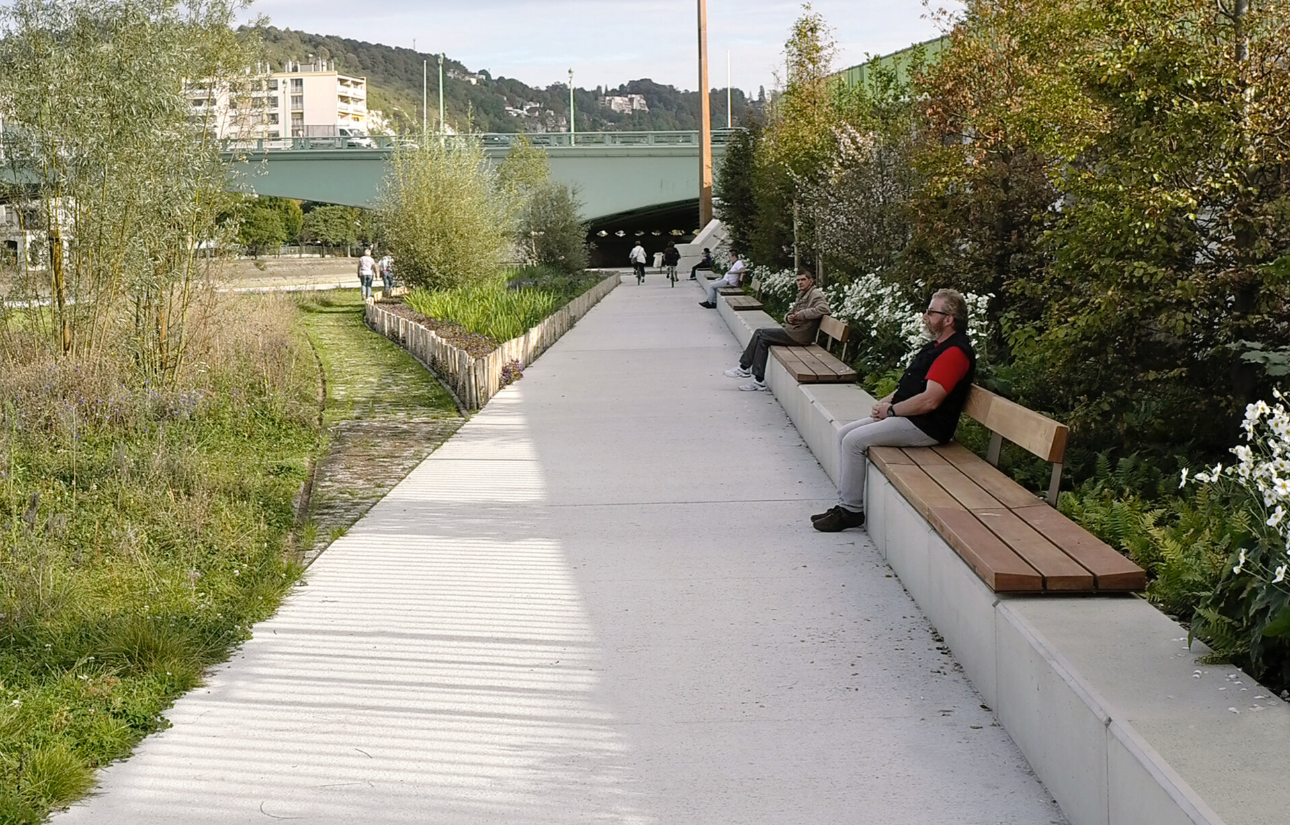
In many cities and municipalities, public space is built around robust but often underused infrastructural structures. Retaining walls, edges and technical borders are usually designed from a purely functional perspective, not with comfort or staying in mind. Yet these elements strongly shape how a square or park is experienced. By equipping this existing mass with ergonomic add-on seating elements, their role shifts from a cold barrier to an inviting place to pause.
This transformation requires no demolition or new foundations. The existing structure acts as a solid base, while the added seating layer introduces warmth and social value, often realised within a single working day with minimal impact on the surroundings. Importantly, these interventions immediately feel finished. Not as temporary fixes, but as recognisable urban furniture, using materials and finishes that are familiar and accepted in the public realm.

Tactical Urbanism as a Tool for Proactive Policy
Tactical urbanism is based on the philosophy of small, targeted interventions that immediately influence and improve how space is used. Instead of waiting for final, static redevelopments, this approach gives cities room to experiment, observe and adjust in a timely manner. Add-on seating elements play a key role in this strategy, as they allow authorities to quickly test where citizens actually need places to rest or meet.
This provides policymakers with direct feedback from real-world use, without committing to irreversible interventions. What proves successful can later be scaled up or integrated into a permanent design, making this approach particularly suitable for station areas, school routes and healthcare campuses in transition. For many decision-makers, this is also a realistic way of working: adjusting based on observed behaviour, rather than planning for years before being able to respond.
From Cold Infrastructure to Ergonomic Seating Comfort
Not every concrete edge invites people to stay. Real comfort only emerges through a considered focus on seating height, tactile materials and ergonomic support. Our add-on seating elements translate raw infrastructure into a high-quality seating experience, intelligently using existing height differences rather than correcting them.

The variety within modular add-on systems allows for different types of use, from individual seats that offer quiet rest to continuous benches that encourage social interaction. The strategic addition of backrests and armrests also serves older users and people with reduced mobility, immediately increasing inclusivity and overall accessibility without compromising the legibility of the original infrastructure.For policymakers, it is reassuring that these solutions rely on familiar, proven materials. Wood and steel feel intuitive, look solid and are logically accepted in maintenance practice, precisely because they have demonstrated their value in urban furniture for decades.
Circular Value and Social Return on Investment
Sustainable management of public assets starts with making the most of what already exists. Upcycling existing retaining walls into fully functional places to stay fits within a circular vision where adding value takes precedence over demolition or replacement. These hybrid solutions reduce material impact while simultaneously improving thermal comfort for users, as wood on concrete feels warmer in winter and cooler in summer.
For policy and maintenance teams, this results in a high social Return on Investment. Active seating areas increase social control and contribute to a stronger sense of safety. Visible results are achieved within a short timeframe, while the modular nature of the elements ensures low maintenance costs and a long functional lifespan. These are precisely the kinds of interventions that make a tangible difference in practice: visible, manageable and defensible in terms of public value.
Applicable Across a Wide Range of Contexts
This strategy can be applied in a wide variety of settings. On village squares, it strengthens the staying function without compromising openness. In parks and green areas, it turns natural edges into usable resting points. In school environments and healthcare sites, it creates accessible meeting places along pedestrian routes. In transit environments such as station forecourts or stops, it responds to the need for short stays without hindering circulation.
In residential areas and shared outdoor spaces, these interventions also add clear value. By activating existing walls and edges, low-threshold seating emerges that encourages interaction without disrupting the character of the surroundings. For residents, this means increased comfort and usability in their immediate living environment, with solutions that integrate quietly and feel safe for all ages.
In professional settings such as office areas, campuses and retail zones, these seating solutions contribute to stay quality and informal interaction. They offer employees and visitors comfortable places for short breaks or meetings, without compromising a professional appearance. Careful detailing and integration on existing structures result in a calm, orderly image that aligns with contemporary working and visitor environments.
By making smart use of existing structures, the space remains legible and easy to oversee. The universal applicability of these solutions ensures that a limited set of modular elements can address a wide range of urban challenges.
From Quick Win to Long-Term Vision
Although these interventions are often deployed as rapid improvements, they are not detached from a broader vision for public space. On the contrary. They frequently form the first step in a phased development, where use and experience guide future investments. By investing today in tactical solutions, cities and designers gather valuable insights for tomorrow. Public space is thus not only designed on paper, but also through use. This enables policymakers to make well-founded decisions for permanent redevelopment. What starts as a quick win becomes a thoughtful, data-informed beginning of a sustainable urban transformation.

FAQ - Frequently asked questions
The activation of a location using modular add-on seating elements can, in most cases, be completed within a single working day. This is made possible by the fact that the elements are prefabricated and designed for direct installation on existing retaining walls or concrete edges. There is no need for demolition, new foundations or curing times, which significantly reduces disruption on site. As a result, public spaces can be upgraded quickly without prolonged closures or heavy construction logistics.
Servibo supports technical departments and contractors with targeted advice and detailed installation guidance, ensuring that the non-invasive installation runs smoothly and daily urban life is not disrupted. Through this advisory role, Servibo enables policymakers to rely on immediately visible results, positioning itself as an agile partner for cities responding to changing societal needs in public space.
For a safe and durable installation, the existing concrete or masonry structure must be structurally sound and capable of supporting mechanical or chemical anchoring. Beyond basic stability, factors such as exposure to weather conditions, anticipated intensity of use and applicable safety standards must also be taken into account. The add-on seating solution is designed to remain fully inspectable and accessible for maintenance, ensuring that both structural integrity and user safety are safeguarded over the long term, even in heavily used public environments.
Servibo’s technical advisors can carry out a preliminary site assessment to verify the integrity of the existing structure and assess feasibility. Policymakers and engineers are advised on the most suitable anchoring method, taking into account substrate density and expected usage intensity. This technical expertise ensures results that not only utilise existing infrastructure, but actively reinforce it for decades to come..
Yes. The add-on seating elements are specifically engineered to withstand intensive daily use and the demanding conditions typical of public space. They are manufactured using robust, proven materials such as FSC-certified hardwood and powder-coated steel, combined with high-quality stainless steel fixings. These fixings are anchored deep into the existing structure, ensuring a high level of resistance against vandalism and unintentional removal.
The modular design further enhances durability, as individual components can be replaced in case of extreme damage without dismantling the entire configuration. Servibo’s design philosophy is rooted in durability by design, combining aesthetics with uncompromising resistance to external influences. Technical specifications and maintenance guidance are provided to maximise lifespan under local conditions, ensuring low Total Cost of Ownership for the managing authority.
Add-on seating elements contribute to inclusivity by transforming existing, often inaccessible concrete edges into comfortable and usable resting points for a broader range of users. Elements such as backrests and armrests, positioned at carefully considered heights, make it significantly easier for older people and users with reduced mobility to sit down and stand up safely. This directly addresses a common barrier in the public realm, where existing infrastructure often excludes more vulnerable groups.
By creating strategically placed resting points along walking routes, the reach of more vulnerable groups within the urban environment is increased. At Servibo, we believe a city truly functions only when everyone can find a place within it. Social inclusion is therefore embedded as a core value in every quick win strategy we advise on.
Within the reality of a political term, authorities are expected to demonstrate visible progress while remaining accountable and consistent in their long-term vision. Quick wins are particularly effective in this context because they are highly visible, relatively easy to implement using existing services, and defensible from a policy perspective. They allow administrations to show tangible improvement in everyday public spaces without committing prematurely to complex, long-term projects.
At Servibo, quick wins are not seen as isolated actions, but as a way to make policy tangible and visible for citizens. We advise on how location activation with add-on seating elements can be both a meaningful improvement in itself and a first step towards future redevelopment. This ensures consistency with long-term policy direction, with Servibo acting as a strategic sounding board for decision-makers.
Budget cycles often require public authorities to operate within predefined financial frameworks, where most resources have already been allocated. Quick win interventions are well suited to this reality, as they typically do not require heavy civil works or large upfront investments. By building on existing infrastructure, costs remain predictable and manageable, allowing these interventions to be accommodated within maintenance budgets or smaller investment envelopes.
Servibo supports authorities by providing upfront clarity on delivery scope and technical conditions for installation. This simplifies internal decision-making, even when timing and resources are limited, as the risk of unforeseen costs during execution is minimal. The result is a full-fledged improvement that remains logical and defensible in both accounting and long-term management.
Within a multi-year planning framework, add-on seating elements can function as an early, tactical phase that delivers immediate benefits while larger-scale projects are still being developed. They allow public spaces to be activated and tested in real conditions, rather than remaining underused until a full redevelopment is completed. This approach supports informed decision-making over time and reduces the risk of investing in solutions that do not align with actual patterns of use.
Servibo acts as a partner in feeding insights from actual use back into policy. By observing how people use new seating areas, cities gather data that can inform later phases of the multi-year plan. A quick win thus becomes not an end point, but a data-driven and thoughtful starting point for sustainable urban development.
From a budgetary perspective, the Return on Investment of add-on seating solutions is significantly higher than that of traditional redevelopment projects. By reusing existing retaining walls and edges, authorities avoid costs related to new foundations, earthworks and complex infrastructure adaptations. At the same time, these relatively small interventions generate immediate social value by improving comfort, encouraging use and strengthening social control in public space.
From a societal perspective, ROI translates into a rapid increase in liveability and social control, directly contributing to a stronger sense of safety in neighbourhoods. Servibo supports cities and municipalities in calculating and maximising this ROI by proposing solutions that deliver tangible results within a single political term. It is a cost-efficient choice that aligns financial responsibility with daily urban experience.
Conclusion
Whether you are a municipal planner, city architect or policymaker, add-on seating elements offer a strategic and versatile approach to improving public space. By building on existing structures, these solutions make it possible to achieve a high level of spatial and social impact without resorting to invasive works or long implementation processes. They respond directly to the growing need for flexible, visible and accountable interventions within contemporary urban policy.
Beyond their immediate effect, add-on seating elements also support a longer-term vision for public space. They allow cities and municipalities to test, observe and refine interventions based on real use, ensuring that future investments are better informed and more resilient. In this way, quick wins become more than isolated actions: they form a pragmatic bridge between short-term improvement and sustainable urban development.
Those looking to translate this approach to a specific location will find in Servibo a partner that works from context, management and use. From initial analysis to installation, we support public authorities and designers in activating existing infrastructure with attention to comfort, durability and long-term value. What starts as a modest intervention can thus evolve into a broadly supported step towards a more liveable and inclusive public realm.