The Escofet 1886 Modulars brochure
Van één module naar een volledig zitlandschap.
Discover how modular concrete seating elements by Escofet 1886 by Molins contribute to depaving, climate resilience and inclusive design.
Find inspiration for squares, parks, campuses and waterfronts, and make room for a future-ready, creative public and semi-public space.
From standalone objects to cohesive seating landscapes
Cities and municipalities look for answers to depaving, heat stress and social liveability. With modular concrete seating elements such as edging seats, benches and green islands you do not design isolated objects but cohesive seating landscapes. They embrace green perimeters, create places to dwell and make the public domain legible and multifunctional.
The Escofet Modulars 2025 brochure is not a product list but a source of inspiration. You will see how a single module can be combined into lines, arcs and corners for squares, parks, campuses and waterfronts, from linear ribbons to multidirectional clusters.
Why modularity in street furniture works: from formal language to public value
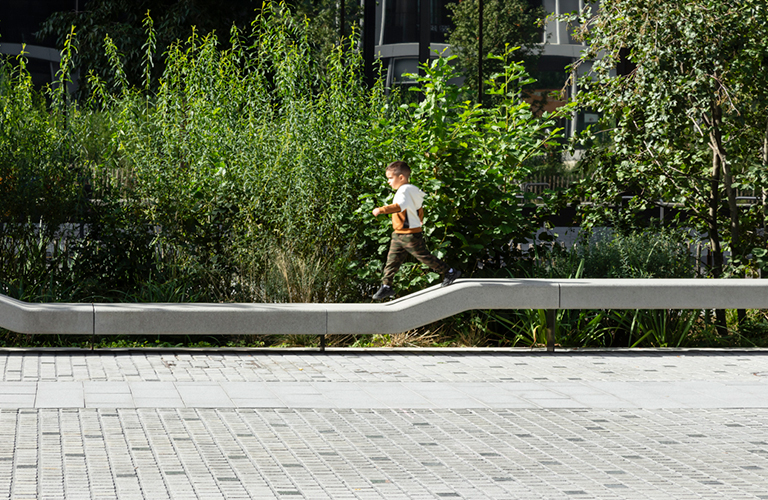
Modularity in street furniture is more than repeating a standard bench. It is the composition of modular elements into shapes that structure the public landscape. Straight runs guide orientation and flow, arcs create shelter and green enclosure, and 90-degree corners define places and meeting areas.
For designers this opens a field of creativity. Modular concrete benches and edging seats are building blocks that can be arranged around valuable trees, planters or existing infrastructure. They help to avoid obstacles without losing the logic of the design, and they make it possible to weave green islands and seating landscapes harmoniously into squares, parks, campuses and waterfronts.
A bench thus becomes more than a place to rest. It becomes a design language that structures space, protects planting and stimulates community life. In the brochure these possibilities are explored in two directions: linear modularity, which brings continuity and rhythm, and multidirectional modularity, which invites flexible patterns, green perimeters and creative compositions.
Depaving and greening: edging seats as a lever for climate adaptation
Cities are under pressure. Paved surfaces trap heat, rainwater cannot infiltrate the soil, and urban quality suffers from heat and monotony. Green infrastructure, such as edging seats with planters, offers a strong answer. This type of layout fits within broader principles of climate adaptation and nature-based solutions aiming to reduce urban heat stress, limit flooding and surface run-off, and strengthen biodiversity.
How modular edging seats contribute
With modular concrete edging seats and green perimeters you can effectively replace paving with green islands. These deliver:
- Better water infiltration during heavy rain
- Lower surface temperatures through reduced heat build-up)
- Local cooling via shade and evapotranspiration
- Space for biodiversity and green meeting points
Powerful patterns that transform street furniture
Combine modules into circular elements, flowing arcs or zigzag patterns around existing trees, planters or infrastructure. This not only creates visually compelling places, but also:
- Natural zones to capture and slow down water
- Active edge networks without major earthworks
- Edging seats that buffer floodwater without structural changes to the subsoil
The importance of depaving
Across Europe, including Flanders, reducing sealed surface is a priority in urban climate plans. Authorities promote permeable surfaces and the creation of green zones in public space. Modular edging seats that make room for green fit perfectly with that strategy. They are durable building blocks that are multifunctional, circular and formative.
A richer toolkit for designers
For designers, modular furniture is a creative toolkit. It gives the freedom to create urban patterns that deliver not only functions such as seating and meeting, but are also climate-resilient, accessible and adaptive. By thinking in form, rhythm and ecology, you connect benches with urban systems such as water sensitivity, shade microclimates or biodiversity zones.
Inclusion in practice: comfort for children, older people and everyone in between
Armrests and backrests support users when sitting down and getting up safely, and they extend dwell time. Varying seat heights make the space attractive to children, young adults and seniors. Sightlines and proximity to green increase the perception of safety and comfort. The modular concrete elements can be used as freestanding arrangements (by their weight) or as anchored configurations (with slimmer profiles), which simplifies maintenance plans and deters vandalism.
Timber as a warm complement to concrete
In addition to their robust concrete base, these modular seating elements can be fitted with timber seat add-ons. Timber softens the visual character of concrete and, above all, increases seating comfort. Combining timber finishes with back- and armrests creates a more natural expression that suits parks, campuses and residential squares.
Ergonomics and accessibility integrated
Ergonomically shaped timber add-on modules ensure edging seats and benches not only feel more comfortable, but also better match diverse user needs. Older users benefit from armrests and correct seat height, while younger audiences appreciate variety in seating forms. This makes inclusion tangible, by integrating aesthetics, ergonomics and accessibility into one modular system.
Material and form: robust aesthetics with UHPC, architectural concrete and wood
Thanks to a versatile material palette, these modular elements are both durable building blocks and aesthetic accents in the public realm. The strength of modularity becomes clear when materials are applied across varied contexts..
UHPC and architectural concrete: durable and refined
Ultra-High Performance Concrete (UHPC) stands out for exceptional strength, low water absorption and high durability, making it ideal for slender elements that remain visible for years.
Architectural concrete is a cast concrete enriched with natural stone aggregates. The result is an aesthetic finish with texture, relief and a richer natural look than smooth concrete or mixes with coarse aggregate. These aggregates produce a timeless, elegant appearance that appeals visually and to the touch.
Timber add-ons for extra comfort and warmth
Modular seating elements in UHPC or architectural concrete form the solid base. On top you can mount timber add-on modules with an internal steel structure for stability. This offers:
- Warmth and comfort: timber softens cool concrete and gives an inviting feel
- Seating variety: ergonomic timber add-ons with or without arm- and backrests, in different depths and heights
- Accessible design: timber makes it easy to integrate ergonomics (e.g. proper seat height and form) and strengthens comfort and inclusion
A modular system that is both aesthetic and functional
Combining architectural concrete with natural stone aggregate or UHPC and ergonomic timber add-ons allows designers to create seating landscapes that:
- Are slender and robust
- Stay visually rich and durable
- Combine comfort with a natural expression
- Align with sustainable architectural principles
Applications where modularity makes the difference
Modularity proves its value in practice. Depending on context, from busy transit spaces to quiet parks, the modular elements add different benefits. Each environment has its own challenges and expectations. With a flexible formal language and durable materials, Escofet Modulars adapt with ease, from the dynamics of station squares to the calm of green parks.
Station squares and campuses
On busy station squares and expansive campuses, modular concrete benches and edging seats bring direction, rhythm and resting points to the daily flow of travellers and students. Linear ribbons guide movement and make waiting areas legible, while perches and work ledges add functionality for short breaks, standing work or informal meetings. Thanks to their modular build, the furniture integrates around desire lines, cycle parking or green structure without hindering circulation. This makes modularity ideal where mobility and dwelling meet.
Squares and parks
In squares and parks, multidirectional clusters reinforce the social function of space. By combining modules into circles, arcs or 90-degree corners, you create anchors where residents meet, children play and older people can sit in the shade. The concrete base can optionally be complemented with timber seat add-ons for extra comfort and warmth. Edges naturally enclose planters or trees, so greening and depaving go hand in hand with social interaction. An empty square transforms into a multifunctional, climate-resilient landscape for dwelling.
Waterfronts and promenades
Along waterfronts and promenades, freestanding solid elements are particularly valuable. Anchoring is often difficult or undesirable due to the subgrade, such as quays, pebbles or timber decks. Thanks to their weight, modular elements remain stable without anchoring. They provide a robust response to heavy use and changing weather, while creating places to sit with a view. In combination with green islands they contribute to cooling and a more natural layout of stony quays. They strengthen both the quality of stay and the ecological value of the waterfront.
School and care environments
In school grounds and care environments the emphasis is on accessibility and inclusion. Modular edging seats allow varied seat heights so children, young people and older users feel equally welcome. Arm- and backrests bring added comfort and safety. For care facilities and nursing homes this means residents can sit independently and stay outside longer. For schools, seating landscapes stimulate group formation and play, especially when placed around trees or green zones. The modular elements contribute to a healthy, social and accessible learning and living environment.
Discover more in the Escofet Modulars 2025 brochure
What you see here is only the outline of what is possible. In the brochure you will find more than visuals: an in-depth look at combination logic (linear and multidirectional), material choices (UHPC, architectural concrete, timber add-ons) and placement principles that make your design buildable.
The Escofet Modulars 2025 brochure is deliberately not a product list but an inspiration guide. It helps you explore form variants, make the right choices for squares, parks, campuses and waterfronts, and see how one module can grow into a complete seating landscape, from straight lines to arcs and corners, from edging seats to green islands. Including insights on inclusive design, ergonomics and material variation.
Would you like to experience how modularity makes public and semi-public spaces future-proof? Get inspired for your next project with the Escofet Modulars brochure.
Questions or suggestions?
Would you like to know more about these modular elements or how they can be applied in your project or public space?
Feel free to email us at info@servibo.be or use the contact button below and we will get in touch.