Between Promise and Reality – How Truly Sustainable Street Furniture Is?
Many materials label themselves as ecological, circular or environmentally friendly. But sustainability goes beyond just labels and recycling. It is about the complete lifecycle, aesthetic quality and transparency in choices. Sustainable street furniture begins with asking the right questions.
Summary
Sustainability is not a label or a marketing claim, but an ambition that in practice, often turns out to be more complex than it first appears. What does it mean when a bench or waste bin is described as circular or ecological? What impact do materials have on lifespan, maintenance, aesthetics and reuse? And how do you interpret sustainability certifications correctly? This article analyses material choices such as recycled plastic, bamboo composite and weathering steel, and explains how certifications such as EPD and B Corp help to objectify decisions. This way you gain insights into the entire lifecycle of street furniture going from design and installation to maintenance and reuse.
The Promise of Sustainable Public Space
Increasingly street furniture is described as “sustainable”, “ecological” or “circular”. These terms sound good, and they align with the ambition of climate‑resilient, climate‑adaptive cities. But when we look more closely at material choice, lifespan, maintenance and aesthetic ageing, we see that practice is often more complex. A manufacturer can use catchy words, but the real added value lies in how that furniture performs over ten, twenty, thirty years. Let us dive deeper into the matter.
Material Choice: More than a Sustainable Label
The growing focus on sustainable street furniture has led to an explosion of material claims. Recycled plastic, circular wood composites, bamboo, weathering steel — each promises ecological added value. Yet it is important to look beyond the first impression. Sustainability is not just in the material itself, but in how it behaves in an urban context: exposed to weather, usage, maintenance budgets and aesthetic expectations. A material that demands little maintenance but quickly discolours or becomes brittle may prove less valuable over time than a heavier but more stable solution.
Anyone shaping public or semi‑public space — whether you are a policy‑maker, developer or landscape architect — needs clear frameworks and clear answers to critical questions in order to make sustainable choices. These questions relate not only to ecological performance, but also to experience, lifespan, flexibility and future‑oriented thinking. What appears a good choice today must still contribute to a high‑quality space in twenty years’ time.
Why EPD and B Corp Matter
Certifications like EPD (Environmental Product Declaration) and B Corp provide valuable reference points in a market where marketing language sometimes overshadows reality. An EPD offers standardised, scientifically underpinned information on the environmental impact of a product throughout its full lifecycle. This makes product comparisons more objective, and fosters transparency in manufacturing. In the case of Escofet, one of the manufacturers we work with, this approach is concretely visible. Read more about EPD certification in street furniture.
The B Corp certification casts a wider net: it assesses the entire operations of a company for social value, ecological performance, transparency and social engagement. For street furniture manufacturers this means: from material choice to how employees and partners are treated. Urbidermis is one such manufacturer walking this path. Read more about B Corp and street furniture.
Ageing Gracefully in the Public Space
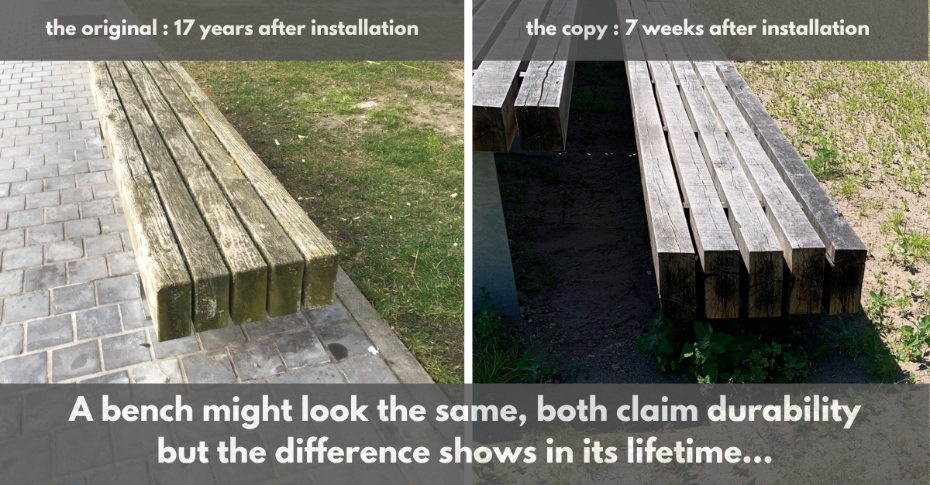
Street furniture is visible. It is present, permanent and determinant for the quality of a square, street or park. Precisely for that reason it is not enough that a bench lasts technically long — it needs to keep visually contributing to the space. Materials such as bamboo composite or recycled plastic have promise, but colour fade, deformation or surface degradation can quickly affect the appearance. Even weathering steel, known for its expressive patina, demands a suitable environment to avoid rust‑runoff issues and uneven ageing.
A long lifespan therefore also needs visual support. That means: the material must age gracefully, maintain its function, and aesthetically fit an evolving urban environment. Visual lifespan is at least as important as technical lifespan, especially in representative or historic contexts.
Maintenance, Reuse and Circular Thinking in Practice
A material that is labelled “circular” on paper does not necessarily perform that way in practice. What matters is how the product is designed: are components modular? Can a component be replaced without discarding the entire unit? Is the product maintenance‑friendly enough to last effectively?
An analysis based on the Total Cost of Ownership (TCO) is therefore as essential as the initial price or the material label. Soon you will read more here in a dedicated analysis of lifetime costs in street furniture. Circular thinking does not automatically mean choosing the lightest or cheapest material, but choosing the one that in its specific context contributes most to continuity, quality and sustainability of the public space.
Without this holistic perspective you risk exchanging a low purchase price for high maintenance and replacement costs in the long run.
Making Space for Better Choices
By asking targeted questions to suppliers and designers, you increase your role as a responsible decision‑maker or designer who wants to improve public space in the long term. Ask not only whether a material is recycled, but also how it behaves in your specific context. How does it age visually? How maintenance‑friendly is it? And what happens when it no longer fulfils its function?
Asking these questions makes the difference between a fashionable choice and a sustainable decision. Choosing street furniture is not a detail — it is a building block of public value.
Conclusion
Sustainability in street furniture requires more than the sum of recycled materials or fashion‑driven claims. It is about insight into the full lifecycle of a design, the ability of a product to age aesthetically, and the flexibility to adapt to changing urban needs. What seems ecological today must also remain functional and visually relevant tomorrow.
Anyone engaged in shaping public or semi‑public space needs clear frameworks and critical questions. Not every sustainability label tells the full story. By looking deeper into material, context and usage over time, decisions can be made that continue to create public value in the long term.
If you would like to delve deeper into the choices suitable for your project, contact us for a conversation — we would be glad to assist in the context, the users and the future‑proofing of your space.
Further Reading
- Read our blogpost article on the EPD accreditation for Escofet 1886.
- Read our blogpost article on the B-Corp Certification for Urbidermis.
- Read the National Circular Economie Programma 2023-2030 from the Dutch Government.
Frequently Asked Questions (FAQ)
Sustainable street furniture includes benches, waste bins, seating elements and other urban components designed to reduce environmental impact while offering long-lasting value, reusability and adaptability. Sustainability is about much more than materials alone. It also involves how products are manufactured, maintained, and dismantled, as well as their potential to evolve with changing needs in public space.
At Servibo, we consider street furniture to be truly sustainable only when it contributes, across its full lifecycle, to ecological performance, functional relevance and aesthetic quality. This approach places equal weight on technical robustness, user experience and environmental footprint, helping cities and communities create resilient and valuable public spaces.
An Environmental Product Declaration (EPD) is a transparent, standardised document that quantifies the ecological impact of a product across its entire lifecycle — from raw material extraction to manufacturing, transport, usage and end-of-life processing. This allows project managers and public authorities to compare products based on verified environmental data instead of relying on vague marketing claims.
Servibo values the implementation of EPDs by our suppliers to emphasize the durability and sustainability of our product assortment. Manufacturers such as Escofet publish EPDs to communicate their environmental impact in a verifiable and comparable way. For anyone involved in public space procurement, this enables more objective decisions that are aligned with sustainability goals and long-term performance expectations.
Read more on the EPD accreditation for Escofet 1886 and the concept of EPD's :
A B-Corp certification is an internationally recognised label awarded to companies that meet high standards in environmental stewardship, social responsibility, employee wellbeing and ethical governance. For producers of street furniture, this means demonstrating a consistent and measurable commitment to positive impact throughout the organisation, from supply chain to management.
Servibo collaborates with B Corp-certified manufacturers like Urbidermis, whose values go beyond profit to embrace sustainability in its broadest sense. For public sector buyers, this certification is not just a label; it is an assurance that the chosen supplier integrates environmental and social values at every stage of the design and production process.
Read more on the B-Corp certification of Urbidermis and B-Corp itself :
Recycled plastic has environmental advantages, particularly because it gives waste streams a second life. However, its performance in public space varies. It is often more vulnerable to fading, warping and surface damage due to exposure and heavy use. In some cases, its aesthetic ageing can reduce its long-term contribution to public perception and space quality.
Servibo recommends recycled plastic only when it matches the functional demands, maintenance expectations and aesthetic criteria of the site. Our view of sustainability goes beyond materials alone, it includes long-term usability, repairability and visual integration in the space. These aspects matter just as much as the recycled content itself.
Visual lifespan refers to how well street furniture retains its aesthetic appeal over time, especially in public spaces where it is constantly seen and used. Even if a piece remains structurally sound, it may lose its contribution to a space if it becomes discoloured, corroded or visually outdated.
At Servibo, visual ageing is considered a core dimension of quality. We help our clients choose products that are not only technically durable but also remain visually coherent, pleasant and relevant for years to come. Public spaces deserve furniture that ages with dignity and continues to enhance user experience and spatial identity.
Truly circular street furniture is designed in a modular way, with individual parts that can be disassembled, replaced, reused or recycled. Circularity also includes design strategies that anticipate future repairs and updates, reducing the need for full replacements and minimising waste over time.
At Servibo, we exclusively work with manufacturers who embrace circular principles from the very first design phase. This includes mechanical fixings, identifiable materials, long-term spare part availability and clear documentation. For us, circularity is not a buzzword, it is a design mindset rooted in practical, long-term value creation.
Choosing sustainable street furniture involves more than material claims or aesthetic appeal. Relevant questions include: How long will it last? How does it age visually? How easy is it to maintain? Are components replaceable? Is there an EPD or other environmental certification available? And how well does it match the specific user group and location?
At Servibo, we guide our clients through these questions with a structured and informed approach. By focusing on lifecycle value, contextual fit and long-term usability, we help public sector stakeholders make smarter, more sustainable choices, not just for today, but for the decades to come.
The materials used in street furniture influence not only the look and feel of a space, but also its durability, maintenance costs and user experience. Well-chosen materials enhance safety, accessibility and visual identity in the public space, especially when they withstand wear, weather and time.
At Servibo, we see material selection as a strategic act, not a technical detail. We help public space professionals evaluate materials for their long-term performance, contextual relevance and contribution to overall spatial quality. Public value is not created by accident, it is shaped by thoughtful, informed design decisions.
Other Questions?
Do you have further questions or would you like personal advice on the sustainability or circularity of street furniture in your city or municipality? Our team is ready to think along with you and provide tailored recommendations — without any obligation. Click on Contact us below and discover how we can work together to create a future-proof and sustainable public space.